

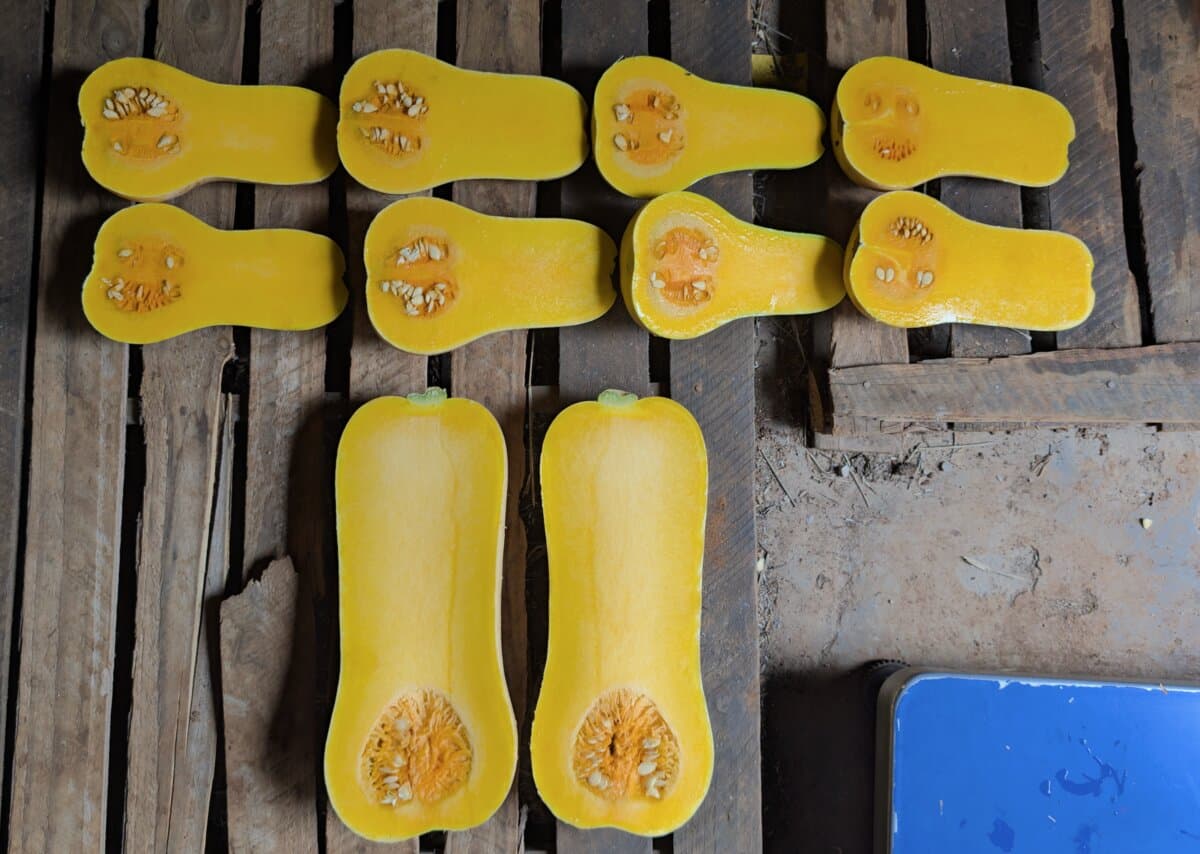
Butternut Variety Trial Results: Harare, Zimbabwe — January 2026
We conducted a butternut variety trial at the Farways Seeds demonstration site in Harare, evaluating three hybrid varieties — Buttler, XBN 49, and XBN 55 — alongside two open-pollinated varieties (OPVs) including a competitor's market-leading OPV.
The trial was sown on 7 October 2025 and harvested on 15 January 2026 (100 days). Sowing was about a month later than the typical planting window, which meant the crop developed into the rainy season — creating ideal conditions to test disease tolerance under real pressure, particularly from powdery mildew.
Trial Setup
| Detail | Value |
|---|---|
| Location | Farways Seeds demo site, Harare |
| Sowing Date | 7 October 2025 |
| Harvest Date | 15 January 2026 |
| Plants per variety | 25 |
| In-row spacing | 30 cm |
| Between-row spacing | 1.5 m |
| Plant population | ~22,000 plants/ha |
Key Results
Yield
XBN 49 was the clear standout, significantly outperforming all other varieties:
| Metric | Waltham OPV | Competitor Seeds | Buttler | XBN 49 | XBN 55 |
|---|---|---|---|---|---|
| Avg. fruits/plant | 2.9 | 2.0 | 2.5 | 3.6 | 1.3 |
| Marketable fruits/plant | 2.3 | 1.9 | 2.3 | 3.4 | 1.3 |
| % Marketable | 79% | 96% | 92% | 94% | 100% |
| Total yield/plant (kg) | 2.3 | 1.7 | 2.1 | 3.6 | 2.5 |
| Marketable yield/plant (kg) | 2.1 | 1.7 | 2.0 | 3.5 | 2.5 |
Fruit Size and Uniformity
- XBN 49 averaged 1.02 kg per fruit — perfect for the Zimbabwe fresh market — and had the lowest variance of all varieties, showing outstanding uniformity.
- XBN 55 averaged 1.9 kg per fruit with more variation, likely improvable with a more intensive fertility programme.
- The OPVs and Buttler all averaged 0.81–0.89 kg.
Quality
- Internal colour: XBN 49 matched the rich orange colour of established local varieties. Excellent market standard.
- Shape: Superior fruit shape with thick necks, maximising flesh yield per fruit.
- External skin: Uniform colour with fewer blemishes — visually very attractive.
- Taste: Very good taste and texture, comparable with local standard varieties. In Zimbabwe, taste reputation travels from consumer to trader to farmer, so this matters.
Disease Tolerance
This is where the Hygrotech hybrids really shone. Planted into the rainy season, powdery mildew pressure was significant. XBN 49 and XBN 55 maintained leaf cover far longer than all other varieties, protecting fruits from both disease and sun burn. Their superior canopy also contributed to better external fruit quality.
What This Means for Farmers
XBN 49 is a game-changer for butternut production in Zimbabwe. It combines:- High yield — 80 t/ha potential, nearly double the OPV benchmarks
- Market-perfect fruit size — consistent 1 kg fruits with excellent uniformity
- Superior disease resistance — ideal for rainy-season production when mildew pressure is highest
- Excellent eating quality — taste and texture that consumers and traders trust
What's Next
- XBN 49 will be introduced as a premium hybrid option through Farways Seeds in Zimbabwe, with commercial seed available before the August–September planting season.
- A 2-hectare commercial trial is already underway in Banket to validate performance at scale.
- Further trials will compare XBN 49 against other premium hybrids from leading seed houses.
Interested in trialling XBN 49 on your farm? Contact us to find out about availability and pricing for the upcoming season.